
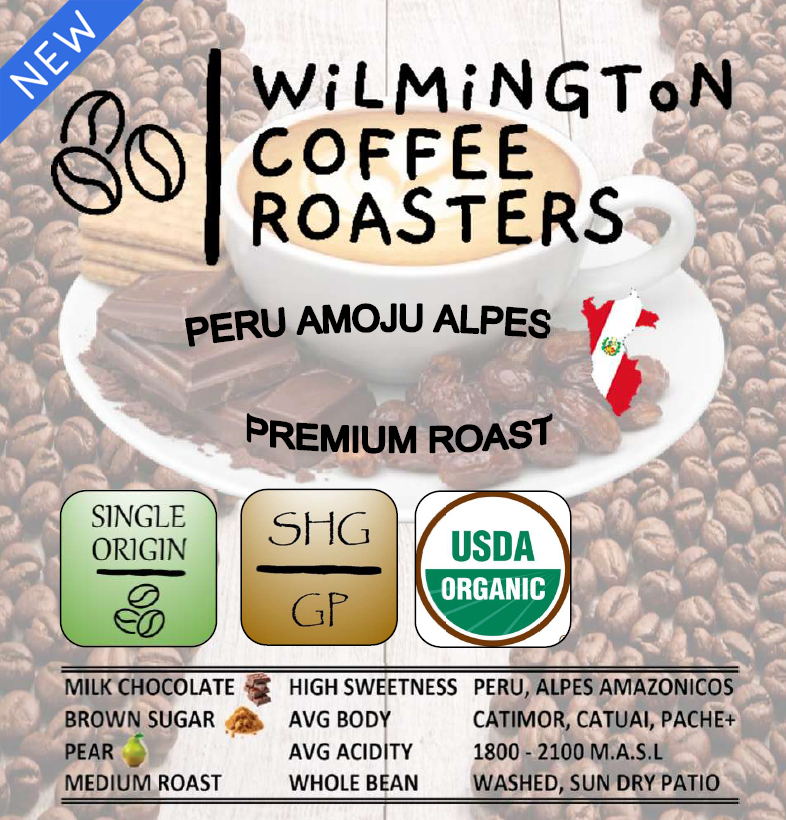
PERU AMOJU ALPES (Organic) - Premium Roast
Whole Bean or Ground Coffee (Medium)
$19.99
Wow! It's been a while, Peru is finally back. So many of you liked it, and we're happy to give you not 1, but 2 Peruvian options right now!!! Choose carefully or choose both! Oh and it's Organic USDA certified!
Tasting Notes | |
Milk Chocolate | High Sweetness |
Brown Sugar | Average Body |
Pear | Average Acidity |
Demographic | |
Origin: | Peru |
Region: | San Igancio Rio Amoju - Alpes Amazonicos |
Producer: | Various Small Producers |
Processing: | Fully Washed |
Process Desc.: | Sun dry on concrete patio |
Altitude: | 1800m - 2100m |
Species: | Catimor, Catuai, Caturra, Pache |
Harvest Season: | May - September |
Type: | Premium Roast |
About This Coffee:
Peru is one of the top 20 coffee producers in the world as of 2014. It ranks fifth in the export of Arabica in the world market.
History of Coffee in Peru:
In 1895, the Journal of the Society of Arts recorded that Peru was known for many years as a coffee-producing country, but the coffee grown on the coast was used primarily for domestic consumption, and it was only later that it developed as an exporting nation. Coffee planting began, and coffee is still cultivated near the port of Pacasmayo. Coffee has been cultivated in the south, in the districts of Sandia and Carabaya, and in the centre of Peru in the valleys of Chanchamayu, Viloc, and Huánuco. Production in Chanchamayo district was facilitated by the completion of the Central (or Oroya Railway) by the Peruvian Corporation. The Chanchamayu Valley, itself about 10 miles (16 km) long, was in the hands of private plantation owners, while the Perené, Paucartambo, and Rio Colorado valleys, were later linked by railway. The first exports of coffee, to Germany and England, did not begin until 1887.
In the 1970s, large dry mills were sited near ports, the transportation network along the Pacific was considered ideal, a model where quantity of production rather than quality was important. This model has changed in recent times with the Agricultural Ministry introducing modern methods, encouraging farmer organizations such as the CENFROCAFE in Jaén, a mountainous area of the Andes.
Coffee Production in Peru:
The three prominent coffee growing areas, located in the eastern slopes of the Andes, are Chanchamayo, the Amazonas and San Martin regions, and the southern highlands. St Ignacio, close to the Ecuadorian border, is the centralized area of coffee plantations in northern Peru. Arabica is the dominant coffee crop, 70% of which is Typica, 20% is caturra, and the remainder being of other types. About 75% of the coffee growing area lies at an elevation range of 1,000–1,800 metres (3,300–5,900 ft), and planting done in the shaded areas is to the extent of 2,000 plants per ha. Farming is done largely by small farmers, and coffee is handpicked. Organic coffee is grown on 90,000 hectares (220,000 acres).
Coffee production in 1893 was about 1,500 tons. According to FAO statistics for 2013, coffee production was 256,241 tons from an area of 399,523 hectares (987,240 acres) with a yield level of 6,414 hectogram per ha.
Coffee produced in the country is mostly exported, and during 2012, 264,343 tons was exported to US, Germany, Belgium, Colombia, Sweden and others, while internal consumption was limited to about 10%. During 2014, coffee rust disease (Hemileia vastatris) affected 130,000 hectares (320,000 acres) in the central highlands of the country causing a decline of 6% in production vis-à-vis the 2013 figure; compared to the highest ever production of 30,900 tons, the shortfall was 15%.